In today’s fast-paced, multi-stream delivery environments, Quality Engineering (QE) plays a critical role in safeguarding product excellence. Yet, QE risks — those uniquely tied to testing depth, coverage, tools, readiness, and integrations — often remain under-represented in broader project risk registers.
To bridge this gap, organizations are increasingly investing in a structured QE Risk Management Framework that not only captures quality risks but elevates them into program-wide decision-making.
🎯 What Is a QE Risk Framework?
A QE Risk Framework is a structured, repeatable approach for identifying, classifying, tracking, and mitigating risks specific to quality assurance activities across the software lifecycle. Unlike generic project risk frameworks, this is QE-led, focusing on dimensions such as:
- Test environment readiness
- Automation coverage and tooling constraints
- Data availability and security
- Integration and system dependencies
- Accessibility and compliance gaps
- Regression and release readiness
- Skill or resource constraints in test teams
🔄 Why Risk Management Matters in QE
QE teams are often the first to sense delivery misalignments — through test failures, environment issues, late requirement changes, or tool limitations. When these signals are captured early and formally, they can drive:
- Proactive issue resolution
- Prioritized test efforts
- Better resource alignment
- Smoother go-live readiness
Without risk management, QE becomes reactive. With it, QE becomes a strategic enabler.
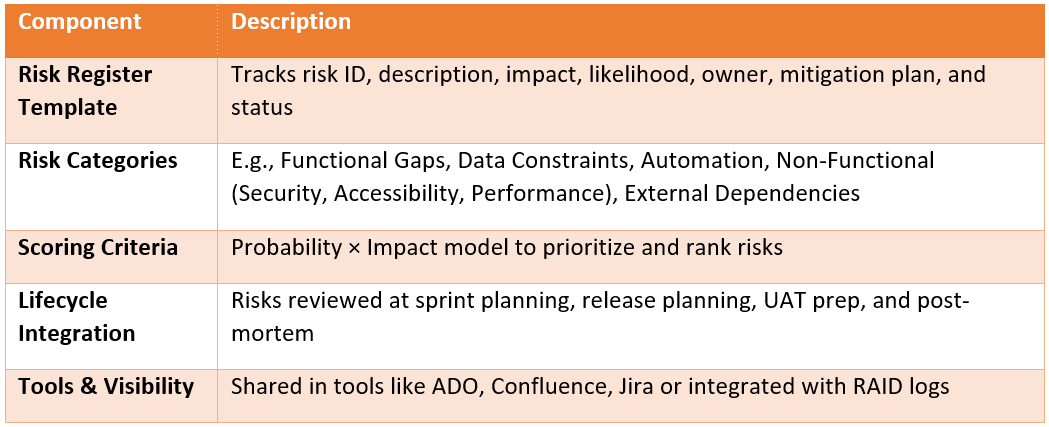
🧱 Key Components of an Effective QE Risk Framework
🧩 Benefits of a Bottom-Up Risk Management Approach
Traditional risk management is often top-down — driven by Program Managers, Portfolio Governance, or PMO. However, QE-led risk identification brings granular insights from the ground up, adding critical value:
- Surface Hidden Risks: Technical gaps or test blockers are often invisible at program level until surfaced by QE.
- Enables Informed Trade-offs: Knowing what’s untested or delayed helps PMs make scope and timeline decisions.
- Drives Cross-Team Accountability: Risks linked to Dev, Ops, or IAM can be escalated with evidence and traceability.
- Connects Risks to Readiness: QE risk health directly influences release go/no-go decisions.
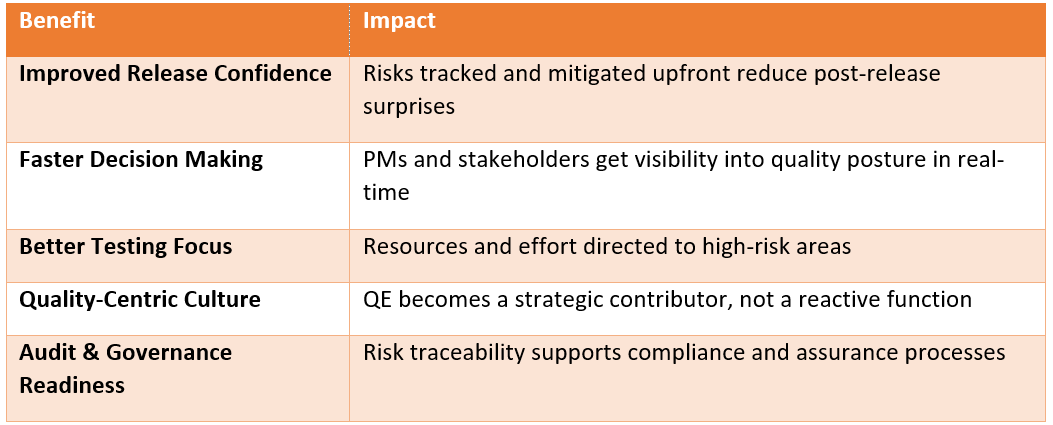
📈 Strategic Benefits of QE Risk Management
📄 Recommended Collateral to Support the Framework
To embed QE risk thinking, consider the following supporting artefacts:
- QE Risk Register Template (customized to your delivery context)
- Risk Assessment Heat Map to show probability vs. impact visually
- Sprint-wise QE Risk Summary (integrated with standups or reviews)
- UAT Entry/Exit Criteria with risk alignment
- Release Risk Dashboard for stakeholder briefings
- Risk Walkthrough Templates (for backlog grooming, refinement sessions)
✅ Real-World Outcomes: What Teams Are Seeing
Organizations who’ve implemented structured QE risk frameworks have reported:
- 40–60% reduction in late-cycle blockers – from my research
- Stronger alignment between testing, delivery, and release teams
- Enhanced confidence from business owners during UAT and go-lives
- Improved incident root cause analysis by tracing missed risks or assumptions
🔚 Conclusion: From Testing Gatekeepers to Quality Strategists
Risk management is no longer the domain of PMs alone. QE teams are uniquely positioned to identify, articulate, and help resolve risks early — if empowered with the right framework.
By embracing QE risk management as a discipline, we move from firefighting to foresight — and transform QE into a strategic pillar of delivery assurance.
Have you embedded a QE risk framework in your delivery model yet? What’s worked best for your teams? Follow this blog for more content like this.
#QualityEngineering #QE #RiskManagement #SoftwareQuality #StrategicQE #TestLeadership #RAID #ProgramGovernance #RiskFramework #DevOps #AgileDelivery #ChandanaJanaswamy
 Strategic Quality Engineering
Leave a comment